

Find our
products online





Find our
products online
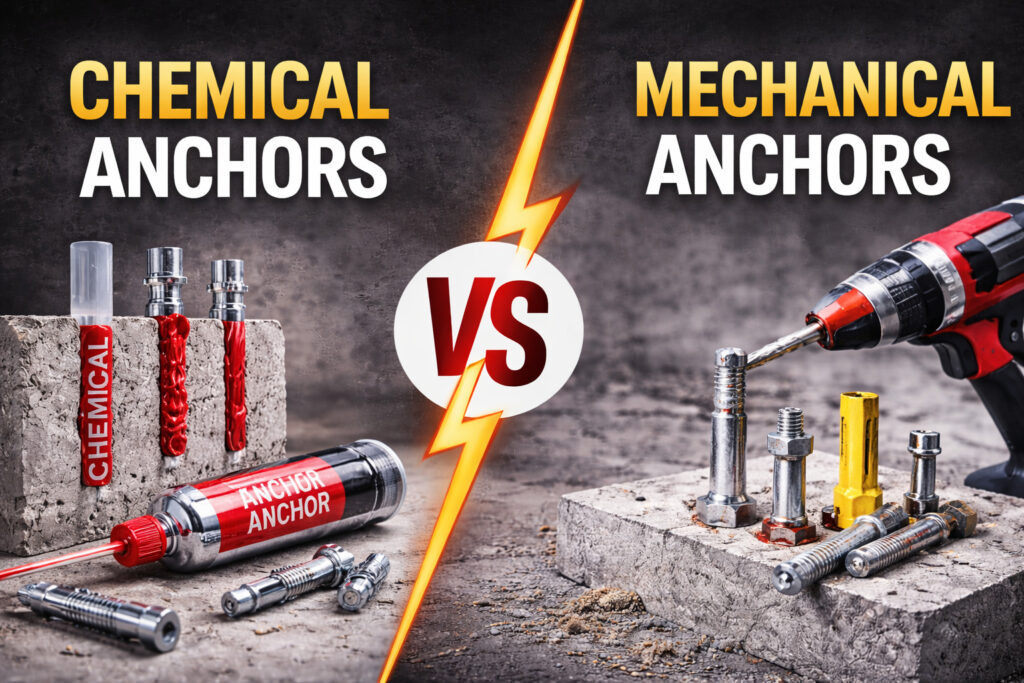
Anchoring systems play a critical role in modern construction, ensuring that structural and non-structural elements remain securely fixed to concrete, masonry, or other base materials. Two of the most widely used anchoring solutions are chemical anchors and mechanical anchors.
While both systems are designed to provide strong and reliable fixing solutions, they operate differently and are suited for different types of applications.
Understanding the difference between these two anchoring systems helps engineers, contractors, and project managers choose the most appropriate solution for their construction requirements.
Chemical anchors are fastening systems that use high-strength chemical adhesive compounds to bond threaded rods, rebars, or anchor bolts into concrete or masonry.
Instead of relying on mechanical expansion, chemical anchors create a chemical bond between the anchor and the base material, resulting in extremely strong load distribution.
See also KWIK Chemical Anchoring System
• No expansion stress on concrete
• High load bearing capacity
• Suitable for cracked and non-cracked concrete
• Ideal for heavy-duty structural applications
• Excellent performance in challenging environments
Mechanical anchors secure fasteners into base materials using expansion forces or friction locking mechanisms.
When the anchor is tightened, it expands inside the drilled hole, creating pressure against the surrounding material. This expansion generates a strong mechanical grip that holds the anchor firmly in place.
See also KWIK Mechanical Anchoring System
• Wedge anchors
• Sleeve anchors
• Through bolts
• Drop-in anchors
• Shield anchors
Chemical anchors distribute load evenly along the anchor rod, while mechanical anchors rely on expansion pressure at specific points.
Mechanical anchors allow instant load application, whereas chemical anchors require curing time before full load capacity is achieved.
Chemical anchors generate no expansion stress, making them ideal for edge installations and close spacing. Mechanical anchors create expansion forces which may cause stress in weaker concrete.
Mechanical anchors are easier and faster to install, while chemical anchors require proper hole cleaning and curing time.
Chemical anchors are better suited for heavy structural loads, whereas mechanical anchors are commonly used for medium to heavy-duty installations.
Chemical anchors are preferred in the following situations:
• Structural steel connections
• Rebar anchoring and extensions
• Bridge construction
• Heavy machinery installation
• Infrastructure and industrial projects
• Installations near concrete edges
See also KWIK Chemical Anchoring System
Mechanical anchors are widely used for:
• Steel brackets and supports
• Railings and guardrails
• Equipment fixing
• Cable trays and pipe supports
• Structural fixtures
See also KWIK Mechanical Anchoring System
Both chemical and mechanical anchors play an essential role in construction. The choice between them depends on factors such as load requirements, base material conditions, installation environment, and project specifications.
Selecting the right anchoring system ensures long-term structural safety, reliability, and performance.