

Find our
products online





Find our
products online
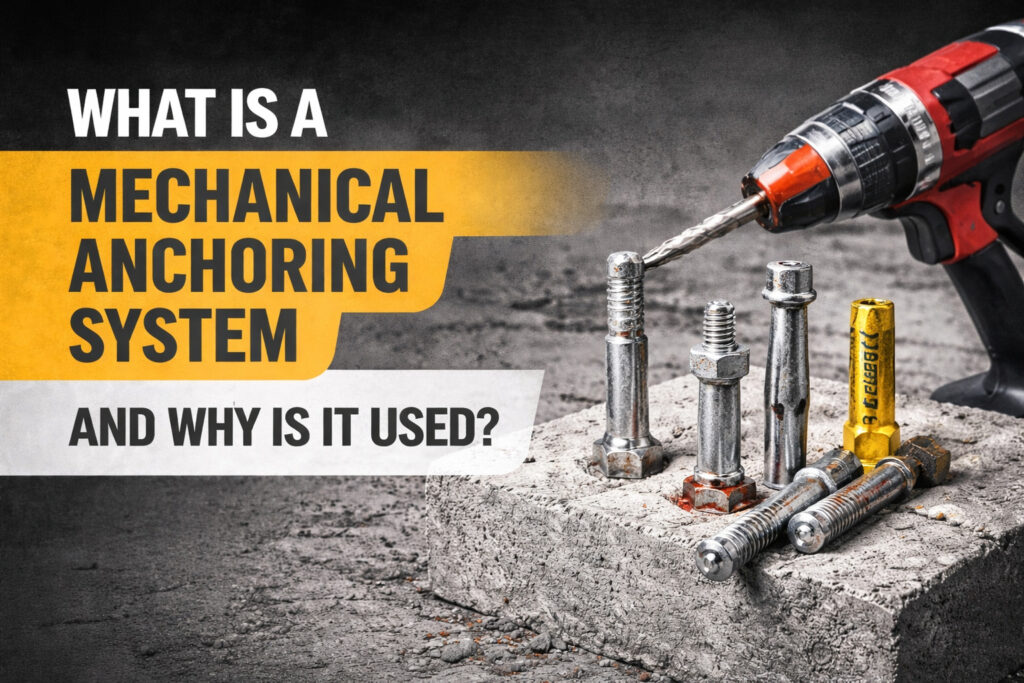
Mechanical anchors are among the most widely used fastening solutions in construction. They provide secure fixing by creating mechanical expansion within the base material, ensuring strong and reliable connections.
Mechanical anchors are commonly used in medium to heavy-duty fixing applications across commercial, residential, and industrial projects.
A mechanical anchoring system is a fastening method that secures bolts or anchors into concrete or masonry through expansion or friction forces.
When the anchor is tightened, it expands inside the drilled hole, creating pressure against the base material. This expansion generates a strong mechanical grip that holds the anchor firmly in place.
Mechanical anchors typically include:
• Wedge anchors
• Sleeve anchors
• Shield anchors
• Through bolts
• Drop-in anchors
KWIK KPT-PRO
KWIK KPT3-PRO
Mechanical anchors operate using expansion forces.
This expansion ensures the anchor remains securely fixed even under heavy loads.
Mechanical anchors are easy to install and require minimal installation time.
Unlike chemical anchors, mechanical anchors can typically bear loads immediately after installation.
They provide dependable performance for a wide range of structural and non-structural applications.
Mechanical anchors offer a cost-efficient solution for many construction fixing requirements.
See also KWIK KPT-PRO & KWIK KPT3-PRO
Mechanical anchors are widely used in:
• Steel structure installations
• Handrails and guardrails
• Structural brackets
• Equipment fixing
• Cable trays and pipe supports
• Machinery anchoring
Mechanical anchors continue to be one of the most efficient and reliable fastening solutions in construction. Their quick installation, strong holding capacity, and wide application range make them essential for many building and infrastructure projects.
See also KWIK KPT-PRO & KWIK KPT3-PRO