

Find our
products online





Find our
products online
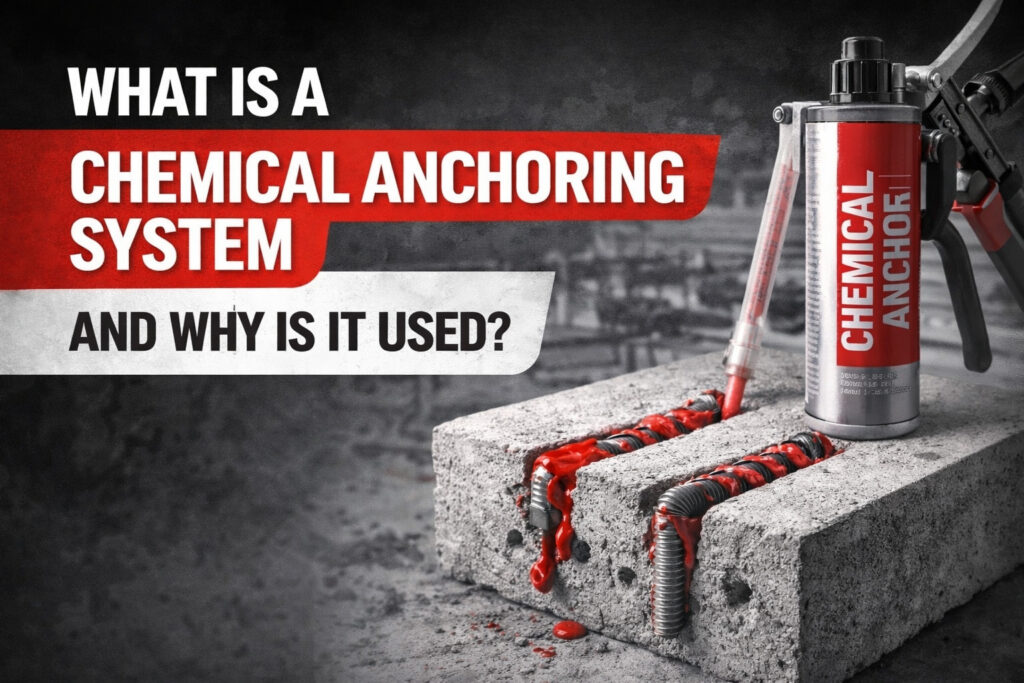
In modern construction, anchoring systems play a critical role in ensuring structural stability and safety. One of the most reliable and widely used anchoring solutions today is the chemical anchoring system. It is designed to provide extremely strong and durable connections between structural elements and base materials such as concrete, brick, and stone.
Chemical anchors are commonly used in heavy-duty construction applications where traditional mechanical fasteners may not provide sufficient strength or flexibility.
A chemical anchoring system is a fastening solution that uses chemical adhesive compounds to secure threaded rods, rebars, or anchor bolts into base materials like concrete or masonry.
Unlike mechanical anchors that rely on expansion forces, chemical anchors create a chemical bond between the anchor rod and the base material, resulting in extremely high load-bearing capacity.
The system typically consists of three main components:
• Chemical adhesive (resin and hardener)
• Threaded rod or rebar
• Base material such as concrete or brick
Once the adhesive is injected into a drilled hole and the rod is inserted, the chemical mixture cures and forms a solid bond that distributes load evenly across the base material.
KWIK RE5000-PRO
KWIK RE1000-PRO
KWIK RE1000
KWIK RE3000-PRO
KWIK VE500-PRO
KWIK PE500-PRO
The installation process of a chemical anchor is relatively straightforward but highly effective.
Once cured, the anchor becomes extremely resistant to pull-out forces, vibrations, and environmental stress.
Chemical anchors provide exceptionally strong bonding strength, making them suitable for heavy structural loads.
Unlike mechanical anchors, chemical anchors do not create expansion forces, which reduces the risk of cracking in concrete.
Chemical anchors can be installed close to edges or near other anchors without compromising structural integrity.
They work effectively in concrete, hollow bricks, solid bricks, natural stone, and masonry.
Many chemical anchor systems are designed to provide long-term durability and corrosion resistance.
Chemical anchoring systems are widely used in various construction and infrastructure projects, including:
• Structural steel connections
• Rebar installation and extensions
• Base plate fixing
• Bridge and infrastructure construction
• Heavy machinery installation
• Facade and railing installation
• Industrial equipment anchoring
With the increasing demand for stronger and more durable construction systems, chemical anchors have become an essential solution in the industry. They provide high performance, reliability, and long-term stability, which are critical for structural safety.
For engineers, contractors, and project managers, chemical anchoring systems offer a flexible and dependable fastening solution for demanding applications.