

Find our
products online





Find our
products online
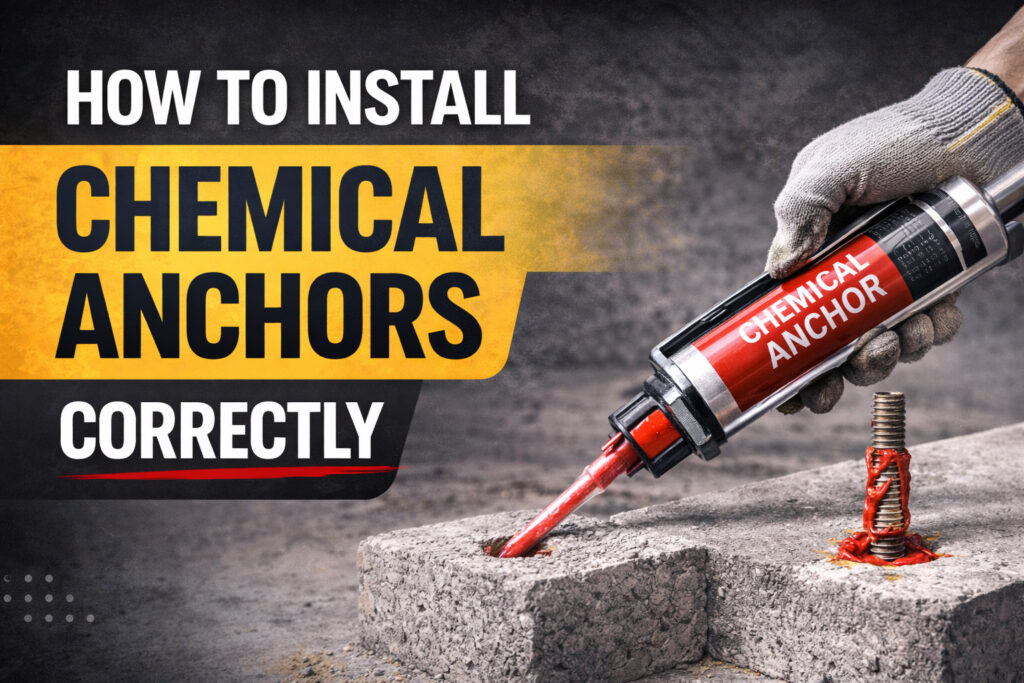
Chemical anchoring systems are widely used in modern construction due to their high load capacity, strong bonding performance, and versatility. However, proper installation is critical to ensure the anchor performs as designed.
Incorrect installation can significantly reduce the strength of the anchor and compromise structural safety.
This guide explains the correct installation procedure for chemical anchors to achieve optimal performance.
Before installation, ensure the following tools are available:
• Rotary hammer drill
• Drill bit of correct diameter
• Hole cleaning brush
• Air blower or compressed air pump
• Chemical anchor cartridge
• Injection gun
• Threaded rod or rebar
See also KWIK Chemical Anchoring System
Drill a hole in the base material according to the required diameter and depth specified for the anchor.
Ensure the drilling is done perpendicular to the surface to achieve proper load distribution.
Proper hole cleaning is critical for chemical anchors.
The standard method involves:
• Blowing out dust with compressed air
• Brushing the hole with a cleaning brush
• Blowing out the hole again
This process removes dust particles that could weaken the chemical bond.
Insert the nozzle into the drilled hole and inject the chemical adhesive starting from the bottom of the hole.
This ensures the hole is filled without trapping air pockets.
Slowly rotate the threaded rod while inserting it into the filled hole.
This helps distribute the adhesive evenly around the rod.
The adhesive must be allowed to cure completely before applying load.
Curing time depends on factors such as:
• Temperature
• Hole depth
• Chemical formulation
Improper installation can reduce anchor strength. Some common mistakes include:
• Inadequate hole cleaning
• Incorrect hole depth
• Applying load before curing
• Using incorrect anchor size
When installed correctly, chemical anchors provide extremely reliable and high-strength fixing solutions. Proper drilling, hole cleaning, adhesive injection, and curing time are essential to ensure optimal performance.