

Find our
products online





Find our
products online
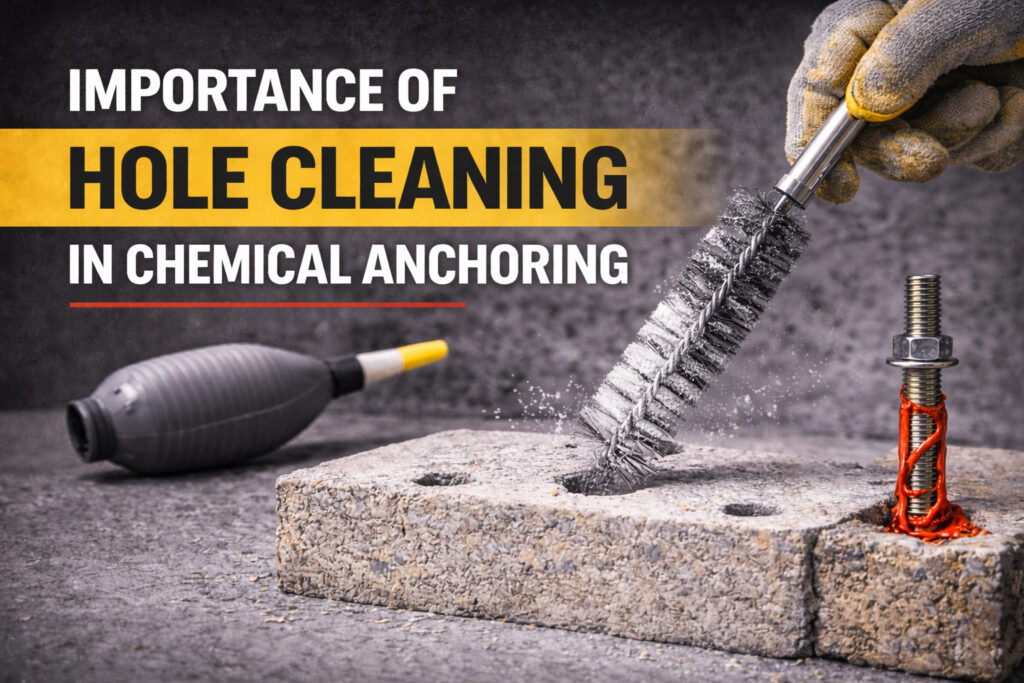
Chemical anchoring systems are widely used in modern construction because of their high load capacity and reliable performance in concrete, brick, and masonry. However, one of the most critical factors that determines the success of a chemical anchor installation is proper hole cleaning.
Even the best chemical anchor product cannot achieve its full load capacity if the drilled hole contains dust, debris, or moisture. Proper hole cleaning ensures that the chemical adhesive bonds directly with the base material, creating a strong and durable connection.
When a hole is drilled in concrete or masonry, the drilling process generates fine dust and debris particles. If these particles remain inside the hole, they act as a barrier between the chemical adhesive and the base material.
This contamination reduces the bond strength and can significantly affect the load-bearing capacity of the anchor.
Proper hole cleaning ensures:
• Maximum adhesive bonding
• Higher load capacity
• Longer service life of the anchor
• Improved safety in structural installations
Dust inside a drilled hole can cause several issues:
Dust prevents the adhesive from bonding properly with the base material.
The anchor may not be evenly surrounded by adhesive, leading to weak spots.
Poor bonding can cause the anchor to fail under load.
Most international fastening standards recommend a blow–brush–blow cleaning method.
Use a hand pump or compressed air to remove loose dust.
Insert a cleaning brush of the correct diameter to scrub the inner walls of the hole.
Remove remaining particles with compressed air.
This process should be repeated until the hole is completely clean.
Professional installation requires the following tools:
• Hole cleaning brush
• Air blower or pump
• Compressed air system
• Vacuum cleaning equipment
Proper hole cleaning is one of the most important steps in chemical anchor installation. It ensures that the adhesive bonds directly with the base material, providing maximum strength and reliability.
Ignoring this step can compromise the safety and performance of the anchoring system.