

Find our
products online





Find our
products online
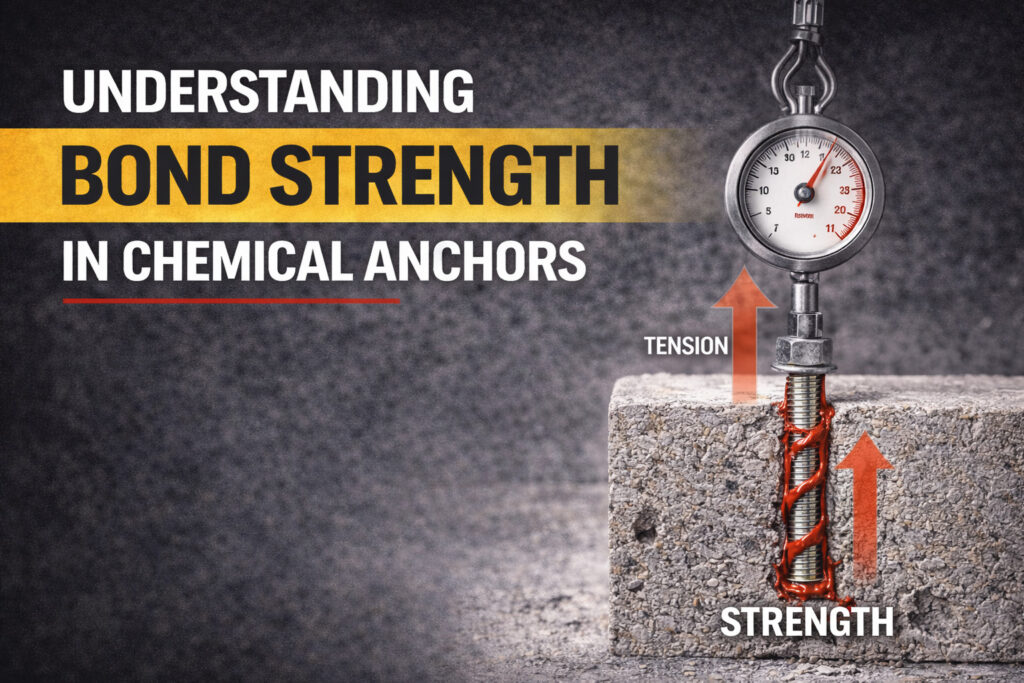
Bond strength is one of the most critical performance factors in chemical anchoring systems. It determines how effectively the anchor transfers loads from the fixture into the base material.
In chemical anchoring systems, the bond strength is created by the interaction between the chemical adhesive, the anchor rod, and the base material.
Bond strength refers to the adhesive force that holds the anchor rod inside the drilled hole.
It represents the ability of the chemical adhesive to transfer loads between the anchor and the base material without failure.
High bond strength ensures that the anchor can withstand heavy loads such as:
• Tensile loads
• Shear loads
• Dynamic loads
• Vibrations
Several factors influence the bond strength of chemical anchors.
Strong concrete or masonry provides better bonding conditions compared to weaker materials.
Proper cleaning ensures direct contact between adhesive and base material.
Deeper embedment generally increases bond strength.
Larger anchor rods can handle higher loads.
Curing and bonding performance may vary depending on temperature.
Bond failures occur when the adhesive bond is weaker than the applied load.
Common failure modes include:
• Adhesive failure
• Concrete failure
• Steel failure
Proper design and installation help prevent these issues.
High bond strength ensures:
• Safe load transfer
• Long-term durability
• Structural stability
• Resistance to environmental conditions
Understanding bond strength is essential for engineers and contractors when selecting chemical anchors. Proper installation and product selection ensure maximum performance and safety in structural applications.